
Italian citizenship by descent is recognized for a person who proves, document by document, that citizenship passed without interruption from an Italian ancestor (the AVO) down to that person’s generation. Since Law 74/2025, that right is no longer unlimited: in general terms it reaches the children and grandchildren of Italians, while great-grandchildren and great-great-grandchildren are left out unless a specific exception applies or a court rules in their favor.
This page explains who can claim it today, by which route and with what risks, based on the rules and case law in force as of November 2026.
Quick summary
- Children and grandchildren of Italians: may apply if one of the cases in Article 3-bis of Law 91/1992 is met. For children, that a parent was exclusively Italian (letter c) or lived in Italy for two continuous years before the child’s birth (letter d). For grandchildren, that a parent or grandparent was exclusively Italian (letter c).
- Great-grandchildren and great-great-grandchildren: the general rule excludes them. Three possibilities remain open: the exceptions in Article 3-bis itself, the judicial route (with an uncertain outcome, because the question is pending before the Court of Justice of the European Union) and residence in Italy.
- Maternal line with a birth before 1 January 1948: recognized only through the courts.
- Broken chain: if the AVO naturalized in another country before the birth of their child, that child did not receive citizenship through that line. If the AVO naturalized while the child was still a minor, transmission is not interrupted. The case still requires individual review.
- DNA test: it does not work for recognition. What is required is documentary proof of each link in the chain.
What Italian citizenship by descent is
Citizenship by descent, or iure sanguinis (“by right of blood”), is the citizenship a person has by being born to an Italian parent. It does not require living in Italy or speaking Italian. A person who claims it is not asking for a favor: they are asking the authorities to recognize a status that, in legal terms, they already hold, provided the chain of transmission is proven.
The historical starting point is 17 March 1861, the date the Kingdom of Italy was established. The Italian ancestor from whom the process starts (the AVO) must have been a citizen when their child was born, and must not have lost citizenship before that moment. The applicable rules depend on the birth date of each link in the chain: the 1865 Civil Code, Law 555/1912 (in force until 15 August 1992) and Law 91/1992, which has applied since then.
What changed with Law 74/2025
Before the reform
Until March 2025 there was no generational limit: it was enough to prove the chain up to an Italian ancestor born after 1861. Decree-Law 36/2025 (28 March 2025), converted into Law 74/2025 (23 May 2025), added Article 3-bis to Law 91/1992.
Cases under Article 3-bis
The rule provides that people born abroad who hold another citizenship are treated as if they had never acquired Italian citizenship, unless one of the following cases applies. It also reaches people born before it came into force.
- Letter a): administrative recognition of an application filed, with the necessary documents, by 11:59 p.m. (Rome time) on 27 March 2025. The earlier rules apply.
- Letter a-bis): an application filed on the day of an appointment that the competent office set and communicated to the applicant by that same date and time. The earlier rules apply.
- Letter b): judicial recognition on a claim filed by 11:59 p.m. (Rome time) on 27 March 2025.
- Letter c): a parent (including an adoptive parent) or a grandparent held, or would have held if still alive, exclusively Italian citizenship at the time of the applicant’s birth or, if earlier, at that ancestor’s death. The applicant bears the burden of proof; statements by the parties are not enough.
- Letter d): a parent or adopter lived in Italy for at least two continuous years, after acquiring citizenship and before the birth or adoption of the child.
The two filters that weigh most
In practice, letter c) concentrates the two filters that weigh most: the generational limit (only the parent and the grandparent count) and the exclusivity requirement (that ancestor must not have held another citizenship). They are different questions and are argued differently. According to Ministry of the Interior circular no. 26185, moreover, Article 3-bis does not create a stand-alone mechanism of transmission and does not repair a chain that has already been broken. Exclusivity is measured at a specific date and is where grandchildren’s cases become most complicated, so it should be analyzed before any application is filed.
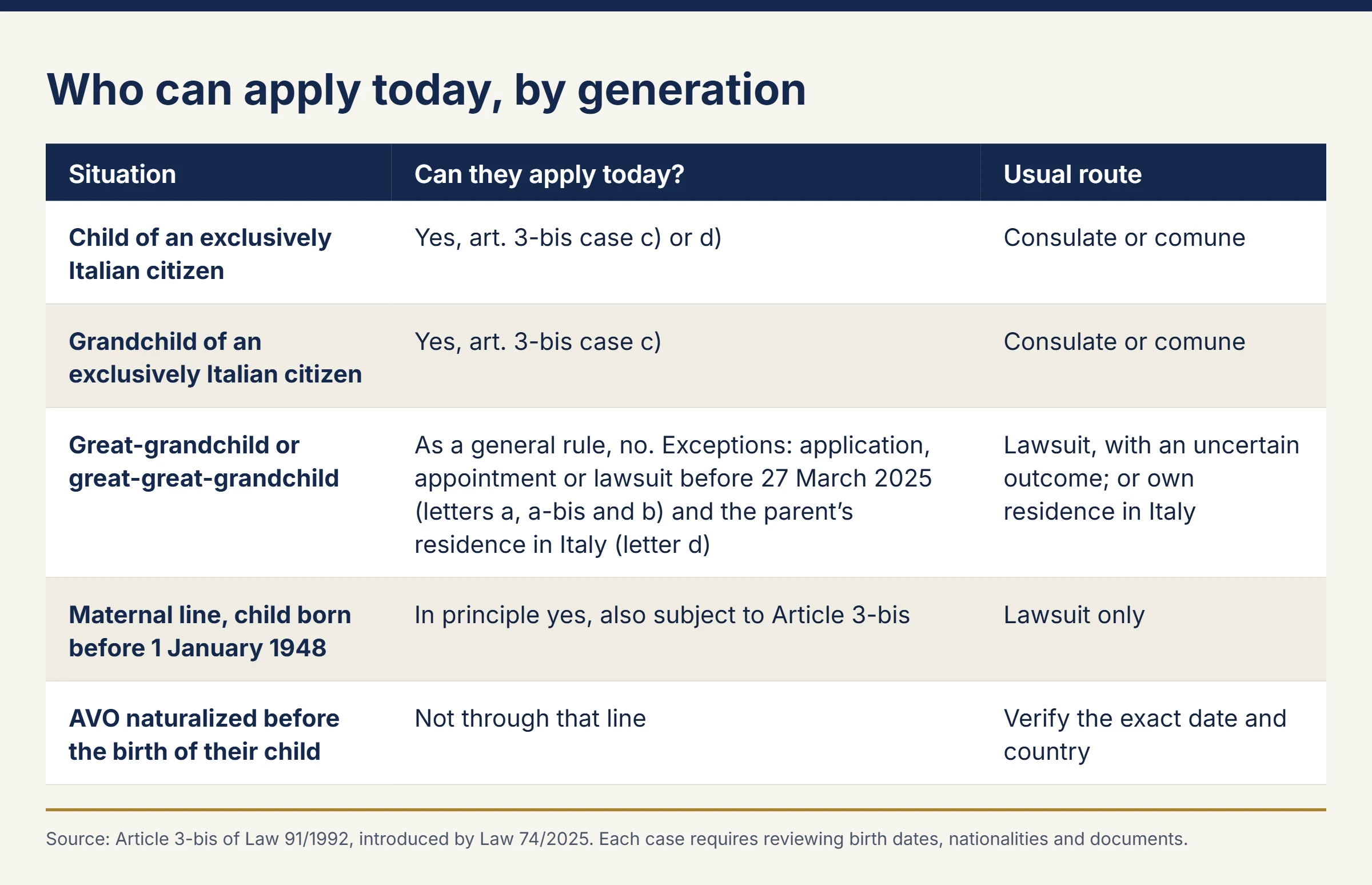
Who can apply today, by generation
The table summarizes the general rule. Each case requires reviewing birth dates, nationalities and documents. General requirements are covered in Requirements for Italian citizenship in 2026 (in Spanish), and the situation of great-grandchildren in this dedicated page.
| Situation | Can they apply today? | Usual route |
|---|---|---|
| Child of an exclusively Italian citizen | Yes, art. 3-bis case c) or d) | Consulate or comune |
| Grandchild of an exclusively Italian citizen | Yes, art. 3-bis case c) | Consulate or comune |
| Great-grandchild or great-great-grandchild | As a general rule, no. Exceptions: application, appointment or lawsuit before 27 March 2025 (letters a, a-bis and b) and the parent’s residence in Italy (letter d) | Lawsuit, with an uncertain outcome; or own residence in Italy |
| Maternal line, child born before 1 January 1948 | In principle yes, also subject to Article 3-bis | Lawsuit only |
| AVO naturalized before the birth of their child | Not through that line | Verify the exact date and country |
Maternal line before 1 January 1948
Under Law 555/1912, an Italian woman did not pass citizenship to her children. The Constitutional Court declared that rule unconstitutional in judgments no. 87/1975 and no. 30/1983, and the Joint Civil Sections of the Court of Cassation, in judgment no. 4466/2009, extended the principle to children born before 1 January 1948, the date the Constitution came into force. As a result, the child of an Italian woman born before 1948 may be entitled to citizenship.
Consulates and comuni do not apply that solution in the administrative route. For that reason this case is handled before an Italian civil court. As a general rule, the competent court is the one seated in the district of the Court of Appeal to which the AVO’s comune of birth belongs.
After the 2025 reform, this line remains judicial and Article 3-bis also applies to it. Additional arguments exist depending on each family’s situation and are assessed when the case is analyzed.
When the chain of transmission is broken
The AVO naturalized before the birth of their child
If the AVO voluntarily acquired another citizenship before their child was born, that child was born to a parent who was no longer Italian and did not receive citizenship through that line. What matters is the order of the dates, which is proven with the child’s birth certificate and the AVO’s certificate of naturalization or non-naturalization. A later reacquisition of citizenship operates going forward: it does not return citizenship to children born while the parent was a foreigner.
The parent naturalized while the child was a minor
Until 2026, the Court of Cassation and the Ministry of the Interior held that a parent’s naturalization caused the minor child to lose citizenship, even if the child had been born with dual citizenship. The Joint Civil Sections of the Court of Cassation changed that position in judgment no. 24045 of 26 July 2026 (section no. 125/2026):
- A minor born abroad to an Italian parent, in a country where citizenship is acquired by birth on its territory, is Italian and foreign from birth. The minor is governed by Article 7 of Law 555/1912 and keeps Italian citizenship even if the parent naturalizes.
- Article 12 of the same law reaches only a minor who held exclusively Italian citizenship.
- The rule applies to naturalizations that took place between 1 July 1912 and 15 August 1992.
Ministry of the Interior circular prot. no. 65050 of 10 August 2026 orders this position to be applied. People who received a refusal based solely on the earlier position may ask for a review of their original application, without filing a new one, before the authority that refused it. If that application was filed, or the appointment was communicated, by 27 March 2025, the limits of Article 3-bis do not apply to them. For naturalizations before 1 July 1912 (1865 Civil Code), the circular for now maintains the principles of Court of Cassation order no. 454/2024.
This decision resolves the merits of the question of minors, but in our view it does not by itself remove the requirements of Article 3-bis. In applications filed after the reform, the exclusivity of Italian citizenship (letter c) must also be analyzed. For families whose ancestor naturalized in the United States, see Italian citizenship when your ancestor naturalized as a U.S. citizen.
Routes to obtain recognition
There are four paths. They are not interchangeable: each corresponds to a different family situation.
1. Administrative route: consulate or comune
A person living abroad files the application at the Italian consulate with jurisdiction over their residence, by prior appointment. A person who moves their residence to Italy may file it with the civil registry of the comune where they register. Since the reform, the file must also show which case of Article 3-bis is met. It is the natural route for children and grandchildren who meet those requirements.
2. Judicial route
It is handled before an Italian civil court, with a lawyer authorized to practice in Italy, and is used in three situations:
- Maternal line with a birth before 1948, which has no administrative solution.
- Refusal or inaction by the administration, including the impossibility of obtaining an appointment before 27 March 2025. The outcome depends on the evidence of the attempts and on the family line.
- Great-grandchildren and great-great-grandchildren who challenge the application of Article 3-bis. It is the most uncertain route, because the question is pending before the Court of Justice of the European Union (see below).
3. Naturalization by residence in Italy (Article 9 of Law 91/1992)
It is not iure sanguinis: it is a grant, not a recognition. After Law 74/2025, a foreigner with a parent or grandparent who was an Italian citizen by birth may apply for citizenship after two years of legal residence (previously three). Because it is not a recognition by descent, its effects on children are not the same and should be analyzed before choosing it.
4. Entry for work for descendants of Italians
Article 27, paragraph 1-octies, of the Consolidated Immigration Act (Legislative Decree 286/1998), added by Article 1-bis of Law 74/2025, allows entry and residence for employed work, outside the annual quotas, for descendants of Italian citizens. The ministerial decree of 17 November 2025 (Official Gazette no. 273 of 24 November 2025) enables it for nationals of Argentina, Brazil, the United States, Australia, Canada, Venezuela and Uruguay. It is entry for work, not recognition of citizenship, but it generates the legal residence that naturalization requires.
For generations more distant than grandparents, the reduced two-year period does not apply: Article 9, paragraph 1, letter a), of Law 91/1992 reaches only a foreigner whose parent or second-degree ascendant was an Italian citizen by birth. The general rule applies: ten years of legal residence (letter f) or, for citizens of a Member State of the European Union, four years (letter d).
How to choose
- Children and grandchildren who meet Article 3-bis: consulate or comune.
- Maternal line before 1948: lawsuit.
- Great-grandchildren and great-great-grandchildren: a lawsuit is possible but uncertain; residence in Italy is more predictable, although it requires living and working there.
Case law and current status in 2026
As of November 2026, the validity of Article 3-bis for great-grandchildren and great-great-grandchildren remains unresolved: the Constitutional Court maintains its reading of the rule, but has asked the Court of Justice of the European Union (CJEU) to clarify its compatibility with Union citizenship.
| Decision | Date | What it decided |
|---|---|---|
| Ministry of the Interior, circular prot. no. 65050 | 10 August 2026 | Applies the Joint Civil Sections’ position to naturalizations from 1912 to 1992 and allows earlier refusals to be reviewed. |
| Court of Cassation, Joint Civil Sections, judgment no. 24045/2026 | 26 July 2026 | Minors born with dual citizenship keep Italian citizenship even if the parent naturalizes (Articles 7 and 12 of Law 555/1912). |
| Constitutional Court, order no. 147/2026 | Decided on 9 June and filed on 23 July 2026 | Joined three cases from the courts of Mantua and Campobasso and referred a preliminary question to the CJEU on Articles 9 TEU and 20 TFEU. Suspended the constitutional proceedings. |
| Constitutional Court, judgment no. 63/2026 | 30 April 2026 | Rejected the constitutional challenges to Article 3-bis raised by the Court of Turin. |
| Ministry of the Interior circular no. 26185 | 28 May 2025 | Instructions for applying Law 74/2025. |
What this means in practice:
- For children and grandchildren, the generational limit is not in dispute. What is discussed is the exclusivity of citizenship and the documentary evidence.
- For great-grandchildren and great-great-grandchildren, the Constitutional Court has already rejected a first set of objections (judgment 63/2026). Attention is now on the CJEU, whose decision has no scheduled date and could take more than a year.
- The ordinary courts have not ruled uniformly: first-instance judgments have gone in different directions.
Required documents
The exact list is set by each consulate, comune or court and must be confirmed before filing. In general the following are required:
- The AVO’s Italian birth certificate, full copy (copia integrale), issued by the comune of birth.
- Marriage certificates and, where applicable, death certificates for each link in the chain.
- Birth certificates for each descendant down to the applicant, and the marriage certificate of the applicant’s parents.
- Certificate of non-naturalization of the AVO, or one showing the date of naturalization, issued by the competent authority of the country of emigration.
- The applicant’s identity document.
- Hague apostille on foreign documents and translation into Italian, as required by the consulate or the court.
- Documents proving the case of Article 3-bis that is invoked: the parent’s Italian record, proof of two years’ residence in Italy or, where applicable, evidence of the application or appointment before 27 March 2025.
- In the judicial route, a power of attorney for the Italian lawyer; in the maternal line, proof that the child was born before 1 January 1948.
A mistake in a name or a date can block the process. Before apostilling and translating, it is advisable to verify that the details match across all records. For those who have not yet identified their AVO, the guide to finding your AVO (in Spanish) explains how.
Timelines, costs and risks
Timelines. There is no single timeframe. At consulates and comuni they depend on appointment availability and workload; in the judicial route, on the competent court. For great-grandchildren and great-great-grandchildren, the CJEU’s decision adds to the wait.
Costs. They depend on the route and the number of people. They include certificates, apostilles, translations and fees and, in a lawsuit, legal fees and the court filing fee. General amounts are not published because they vary by family; they are quoted after the case is analyzed.
Risks to know before deciding:
- Administrative refusal for failing to prove a case under Article 3-bis or because of errors in the records.
- Uncertain outcome in lawsuits for great-grandchildren and great-great-grandchildren: the CJEU’s decision may or may not be favorable.
- Legislative changes: bills have been introduced that propose modifying the current regime. This page will be updated if any of them is approved.
- Promises of results: neither the administration nor the courts guarantee timelines or outcomes. Any offer that does so should be treated with caution.
Frequently asked questions
What is Italian citizenship by descent?
It is the recognition of Italian citizenship for a person who was born to an Italian parent or descends from an Italian citizen and can prove, with documents, that citizenship was transmitted without interruption. It is also called iure sanguinis or citizenship by right of blood.
Up to which generation is it recognized in 2026?
As a general rule, up to children and grandchildren of Italians, provided that one of the cases in Article 3-bis of Law 91/1992, introduced by Law 74/2025, is met. Great-grandchildren and great-great-grandchildren are excluded, except for specific exceptions or a favorable court decision.
My great-grandfather was Italian. Can I apply for citizenship?
Through the administrative route, generally no, unless an application or an appointment exists from before 27 March 2025 (or a lawsuit filed by that date), or a parent lived two continuous years in Italy before the applicant’s birth. The judicial route exists, but its outcome is uncertain because the question is pending before the Court of Justice of the European Union. Residence in Italy is also an option. More detail is on the page about great-grandchildren and the 2025 reform.
What happens if my grandfather or great-grandfather naturalized in another country?
It depends on the date. Where the AVO naturalized before the birth of their child, citizenship was not transmitted through that line. In the case of a later naturalization, in general the chain is not broken for that child. If the child was a minor when the parent naturalized, the position of the Joint Civil Sections of the Court of Cassation applies (judgment 24045/2026).
Does the maternal line have different rules?
Yes. Children of an Italian woman born before 1 January 1948 are entitled to citizenship, but that recognition can only be obtained through the courts. Those born from that date onward are handled like the paternal line.
Is it necessary to speak Italian?
No. Recognition by descent does not require knowledge of the language. That requirement applies to other routes, such as naturalization.
Is it necessary to live in Italy?
Not for the consular route or the judicial route. Yes if the application is filed with the comune, because residence must be established there, and also for naturalization by residence under Article 9.
Does a DNA test work?
No. Recognition requires documentary proof of each link in the chain through civil registry records. A DNA test does not replace it.
How long does the process take?
There is no single timeframe. It depends on the route, on appointment availability or the court, and on how solid the documentation is. Any promise of exact timelines should be treated with caution.
Is recognized citizenship passed on to children?
It depends. If the recognized parent was born abroad and holds another citizenship, their children born abroad acquire Italian citizenship only if one of the cases in Article 3-bis is met, for example two continuous years of the parent’s residence in Italy before the birth. Minor children already born have their own rules.
Is a lawyer needed?
In the administrative route the application can be filed without a lawyer. In the judicial route, representation by a lawyer authorized to practice in Italy is mandatory. Whatever the route, a prior analysis of the family line avoids preventable refusals.
What is the difference between recognition and naturalization?
Recognition by descent declares a citizenship that, under Italian law, the person has held since birth. Naturalization, by contrast, is a grant by the Italian State to a person who meets requirements such as legal residence. Its effects on children are different.
Assessing a case
Each case depends on specific dates, nationalities and documents. The first step is to reconstruct the family line and verify which case of Article 3-bis may apply. If a case is not viable, that will be said clearly.
- If a lawsuit is being considered (great-grandchildren, great-great-grandchildren, maternal line before 1948 or lack of an appointment): free initial meeting. Book a meeting
- For other questions (requirements, documents, administrative route): 45-minute consultation, €67. Book a consultation
- In writing: WhatsApp
Legislation and sources
Legislation
- Law no. 555 of 13 June 1912, in force until 15 August 1992.
- Law no. 91 of 5 February 1992, with Article 3-bis (limit on transmission) and Article 9 (naturalization).
- Decree-Law no. 36 of 28 March 2025, converted with amendments into Law no. 74 of 23 May 2025.
- Legislative Decree no. 286/1998, Article 27, paragraph 1-octies, and the ministerial decree of 17 November 2025 (Official Gazette no. 273 of 24 November 2025).
Ministry of the Interior circulars
- Circular prot. no. 65050 of 10 August 2026 (text, in Italian).
- Circular no. 59/2025 of 17 June 2025.
- Circular prot. no. 26185 of 28 May 2025.
- Circular prot. no. 43347 of 3 October 2024, superseded to the extent indicated by circular 65050.
Case law
- Constitutional Court, order no. 147/2026 and press release of 23 July 2026.
- Constitutional Court, judgment no. 63/2026.
- Constitutional Court, judgments no. 87/1975 and no. 30/1983.
- Court of Cassation, Joint Civil Sections, judgment no. 24045/2026.
- Court of Cassation, Joint Civil Sections, judgment no. 4466/2009.
- Court of Cassation, order no. 454/2024.
Last updated: 3 November 2026.
Recent Comments